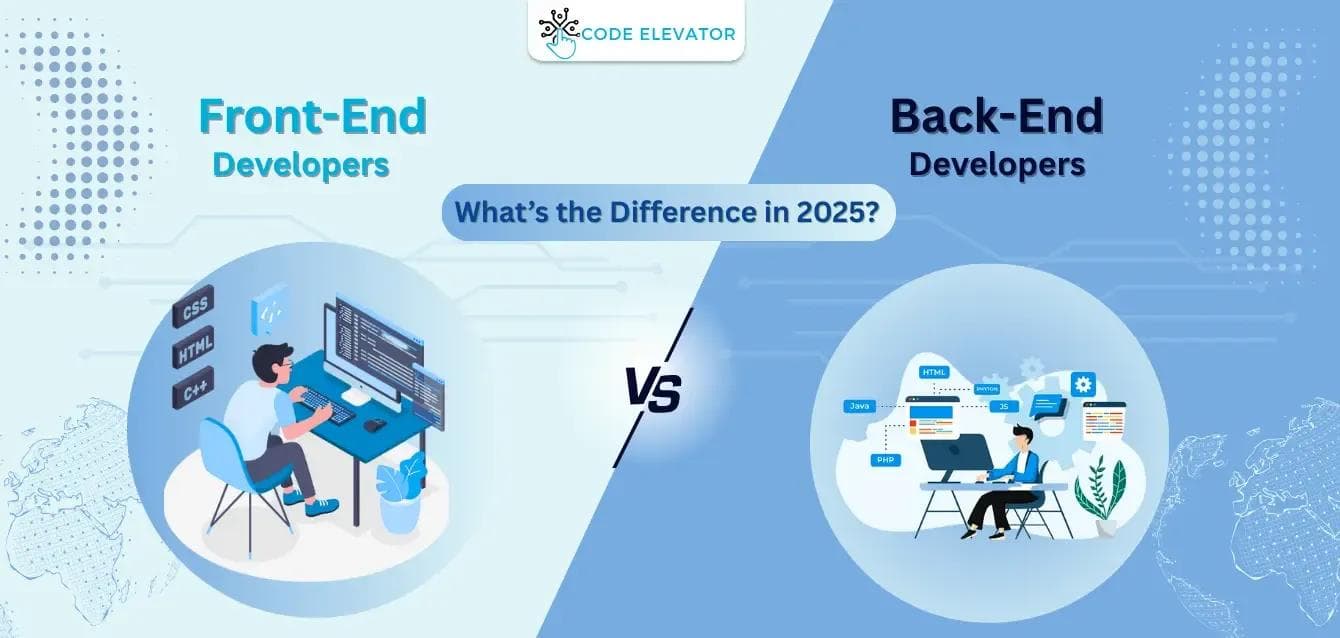
Front-End vs. Back-End Developers: What’s the Difference in 2025?
Table of Contents Introduction The debate between front-end and back-end development will be more important than ever in 2025. Businesses rely on powerful websites and well-designed applications in order to attract…

Contents
- Table of Contents
- Introduction
- What is Front-End Development?
- Definition of Front-End
- What is the role of Front-End Developer?
- Front-end development requires specific skills
- Front-end web development tools and technologies
- What is back-end development?
- Definition of back-end
- Responsibility of back-end developers
- What Skills are Required for Back-end Development?
- The back-end Development Tools and Technology
Table of Contents
Introduction
The debate between front-end and back-end development will be more important than ever in 2025. Businesses rely on powerful websites and well-designed applications in order to attract customers, improve operations and differentiate themselves from their competitors. Behind every functioning website is the work of both front-end and back-end developers: two roles that, while similar in appearance, are actually fundamentally different.
Imagine a website as a car. The front is its sleek design, the dashboard and the controls you use, while the back is its engine, transmission and the mechanical systems that make it work. The other would be incomplete without the first.
The article explains the differences between back-end and front-end developers. It also outlines their respective responsibilities and how they collaborate to create the digital products that we use every day. You’ll learn what front-end and back-end development are, their differences, and the career paths that might suit you.
What is Front-End Development?
Definition of Front-End
Front-end, or client-side, development focuses on the user interface and everything they can interact with. You’ve probably interacted with a front-end developer if you have ever clicked on a button or scrolled down a menu.
What is front-end Website Development?front-end website development is the design and coding of the elements of a site that the user directly experiences. This includes fonts, colors and buttons as well as images and navigation.
What is the role of Front-End Developer?
Front-end web developers are responsible for designing responsive and user-friendly interfaces to ensure smooth browsing. They must combine creativity and coding to transform static designs into digital products.
The following are key tasks:
- Translating UI/UX designs into code
- Ensure cross-device compatibility and cross browser compatibility
- Optimizing website performance for accessibility and speed
- Implementing interactive features using JavaScript
Front-end development requires specific skills
You need to have both creative and technical skills in order to be a successful front-end engineer. In 2025, the following skills will be in high demand:
- HTML, CSS and JavaScript are the holy trinity for front-end code.
- React, Angular and Vue.js are front-end frameworks.
- Mobile-friendly design principles: Responsive Design Principles
- Performance optimization standards and accessibility standards
Front-end web development tools and technologies
The front-end developer relies on many tools and technologies.
- Git, GitHub and other version control systems are popular.
- CSS preprocessors like Sass and LESS
- JavaScript frameworks such as React or libraries like jQuery
- Figma, Adobe XD or Sketch are all design tools.
The technologies available today allow for the creation of interactive and polished user experiences.
What is back-end development?
Definition of back-end
The backend is what makes apps and websites work. It is not visible to the user. The back-end refers to server-side logic and databases that process and store information.
This is done in the background when your log-in details are compared to a database.
Responsibility of back-end developers
Back-end developers ensure that data is flowing smoothly between the application and server. They are often responsible for:
- Writing server-side logic
- Database management and optimization
- Create and integrate APIs
- Ensure data security
- Scalability and performance of applications
What Skills are Required for Back-end Development?
The back-end developer must possess a solid foundation in problem solving and programming. The following are core skills:
- Python, Java and PHP are all programming languages.
- MySQL, PostgreSQL and MongoDB are database management systems.
- Know APIs, including RESTful (GraphQL), and GraphQL
- Cloud computing and server management (AWS Azure Google Cloud).
- Cybersecurity: Protecting user data

The back-end Development Tools and Technology
Back-end developers use:
- Django Express Spring Boot Laravel
- Database management tools such as pgAdmin and phpMyAdmin
- Nginx, Apache and other server tools
- Containerization with Docker Kubernetes
What are front-end and back-end programming?
Front-end and backend programming are two sides of the web: One is focused on interaction with users, while the other is concerned with behind-the-scenes functionality. Frontend and backend development are two halves of web design. One focuses on user interaction, the other is concerned with behind-the-scenes functionality.
What are the main differences between Front-End and Back-End development?
The User Experience vs. the Server-Side Logic
Focus is the most obvious difference between back-end and front-end developer roles. Front-end development focuses on creating interactive and visual experiences. back-end vs.front-end development focuses on the processes behind those visual experiences.
Comparing Frameworks and Languages
- front-end: HTML, CSS, JavaScript, React, Angular, Vue.js
- back-end: Python, Java, PHP, Node.js, Ruby, databases, APIs
The languages and frameworks show how different front-end and backend programming is.
front-end Web developer vs back-end Web developer
Comparing front-end web developers with back-end web developers reveals complementary, but distinct, tasks.
- Focus on front-end development = design and usability
- Focus on logic, data security, and performance for back-end developers
What is the difference between front-end and back-end programming?
- Front-end programming is visible, interactive and client-side code.
- Data-handling and server-side programming is back-end programming.
In 2025, front-end and backend programs will be a part of each other.
Back-end vs Front-end Development Approaches
Backend and frontend development require different methods of implementation.
- Front-end engineers place a high priority on responsiveness, aesthetics, and accessibility.
- The backend engineers are focused on reliability, speed and scalability.
Modern web development requires both.
Frontend and Backend developers working together
Collaborative Work: It's Important
It doesn’t matter how good a backend developer or front-end developer is, they can neither build a product that works on their own. When frontend and backend development are combined, websites and applications flourish.front-end development ensures that users have an intuitive user interface while backend ensures data, logic and servers are working flawlessly.
Imagine that you are in a restaurant. The front is the seating area with menus and the wait staff who interact directly with the customers. At the back is the kitchen, where the chefs cook the meals. The dining experience will be ruined if these two departments do not work together.
Frontend and Backend Coding integration
Frontend and Backend Coding rely heavily on APIs for seamless integration. The APIs serve as a bridge between the user’s input on the front-end (such as a search query), and the data retrieval from the backend.
The following are the key aspects of integration:
- Data flow: ensure requests and responses to be smooth
- Security: protecting sensitive information during transfers
- Performance: Balancing Speed and Efficiency for Real-Time Interactions
Full-Stack developers as a bridge
Full-stack developers are experts in front-end and back-end programming. They are able to create end-to-end apps without the need for two specialists because they understand both sides.
As startups and enterprises alike continue to value web developers who are able to handle both frontend and backend development, the demand for these professionals will increase.
Real World Examples of Collaboration
- Back-end developers are responsible for managing payment systems, inventory and databases. Front-end developers create shopping carts.
- Streaming Services: While the front-end handles players, recommendations and content delivery, the back-end ensures account authentication and secures access to accounts.
Back-end security and transaction management is ensured by the backend of banking apps.
Career Paths: Front End vs. Back End Developer in 2025
Comparing Salary
Salary gaps between front-end and back-end developers vary depending on industry, location, and skills. Backend developers will likely earn a little more in 2025 due to the complex server-side programming, database management and other skills. Frontend engineers who are experts in advanced frameworks, UI/UX and design command high salaries.
On average:
- Front-end developers earn between $70,000 and $110,000 per year
- Backend developers earn between $80,000 and $120,000 per year
Full-stack Developers: 90,000 to 140 000 dollars annually
Employment and Industry Forecast
The demand for front-end and back-end developers is high, as more companies move online. Web development is expected to continue to increase in demand through 2030, according to reports from the industry.
- For projects that require interactive design and mobile first, frontend engineers will be in high demand.
In industries such as finance, healthcare and SaaS, data handling is crucial.
What path should you choose?
Front-end development may be for you if you love design, creativity and the user experience. If you enjoy logic, databases and problem solving, then back-end development may be the right fit for you.
In 2025, full stack developers are a great option for those seeking versatility and flexibility in their careers.
Hybrid Frontend/Backend Developers are on the Rise
Companies are increasingly looking for developers that can work in both frontend and backend. The hybrid roles do not require extensive expertise, but having a working understanding of both frontend and backend coding can make professionals more adaptable and valuable.
The Future of front-end and back-end Development
AI and Automation in Web Development
Artificial intelligence has reshaped frontend and backend programming. AI-driven software now helps with:
- Code generation: speeding up development cycles
- Customizing front-end experiences for users
- Monitoring security: finding vulnerabilities in the backend systems
The Impact of Low-Code/No Code
Platforms with low-code or no-code simplify development. They can’t replace frontend and backend development expertise. These platforms are more like assistants, which allow developers to concentrate on complex tasks.
Full-Stack development is becoming increasingly important
Full-stack developers are in high demand due to the growing need for hybrid frontend/backend developers. A single developer who can handle both ends of the development process is more efficient and saves companies money.
Frontend and Backend programming predictions for 2030
- The front-end will use AR/VR technology to make the development more immersive.
- Cloud-native architectures and serverless technologies will be increasingly used for back-end development.
- Collaboration between frontend and backend developers will become the norm, not the exception.
Conclusion
The answer to the debate between front-end and back-end is not which one is “better”, but how the two complement each other. Back-end development is responsible for reliability, data security, and performance.front-end development creates our daily user interface. Together they are the engine of the modern Internet.
If you want to become a professional in the digital world, then 2025 will be an ideal year for your career. The two career paths have a high demand and offer rewarding salaries as well as the chance to help shape tomorrow’s digital world.
FAQs
1. What's the difference between front-end and backend?
The back-end is concerned with the logic and data on servers, as well as performance.
.elementskit-card END
2. Is it possible to have a single developer work on both the front and back-end?
Full-stack developer professionals will be highly sought after in 2025.
.elementskit-card END
3. In 2025, is front-end development easier than backend?
The front-end tends to be more visually-oriented, with a design focus. While the back-end tends to be more logically-oriented and technically-minded. Both have their own unique challenges.
.elementskit-card END
4. How would you define front-end and back-end programming?
front-end = client-side (user interface). The back-end is the server (logic and data handling).
.elementskit-card END
5. What is the better career: Frontend Engineer or Backend Developer?
The two are both excellent choices. It depends if you are more interested in creativity, design and logic (front-end) or problem solving and logic (back-end).
.elementskit-card END

Articles from the Code Elevator team, the engineers and specialists who vet developers, ship client work, and write up what they learn along the way.
More from CodeFour clients, on camera.
Why he brought his development work to Code Elevator.


One useful piece a month, no more than that.
What we learned building and hiring for this work. No newsletter filler.
Reading about it is step one. Building it is step two.
Hire a pre-vetted engineer who has shipped work like this before. Matched within 48 hours.
We reply within an hour during our working day in India and the UAE.