
⏱ 9 min read
A crypto exchange MVP is where a lot of founder plans go sideways. The mistake is rarely “we forgot one feature.” It is usually the opposite. The team tries to launch spot, margin, futures, staking, Earn, a launchpad, mobile apps, and three jurisdictions at once. Then budget slips, compliance scope doubles, and the product that finally appears is late and unstable.
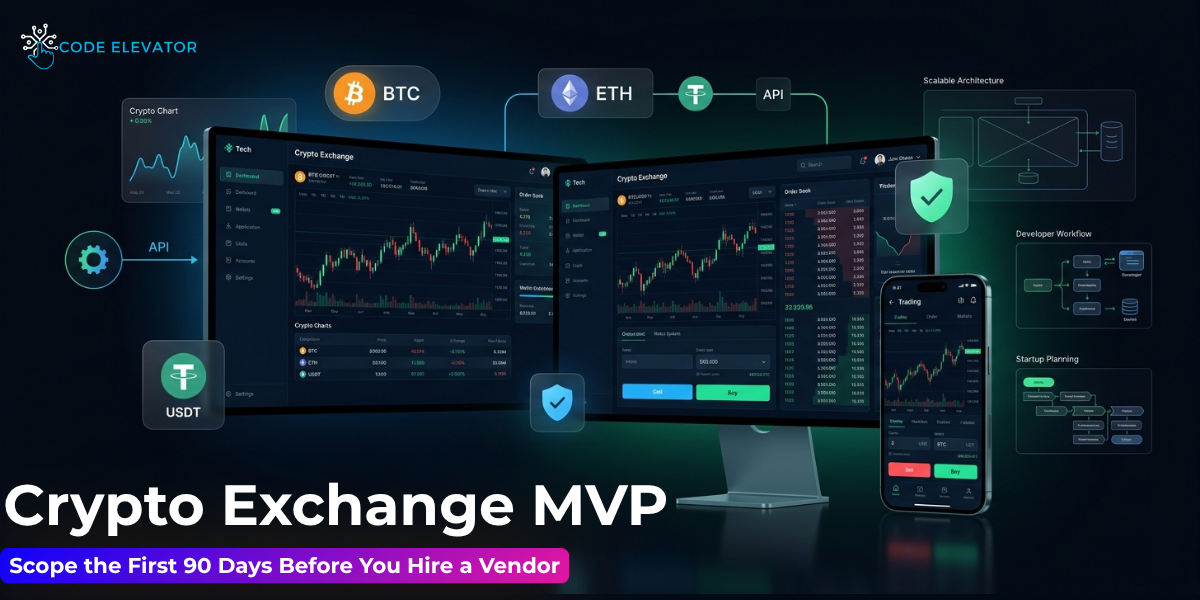
That is why a real crypto exchange MVP is not a stripped-down demo. It is a live-money product with strict boundaries. It needs to custody assets, approve or block withdrawals, onboard users with KYC, and support real spot trading without turning day one into an incident-response drill.
For most early-stage teams, the right target is narrower: one jurisdiction, a small asset list, a responsive web frontend, and the minimum modules needed to run a spot market safely. If you can hold that line before vendor talks, your timeline, cost, and architecture decisions get much clearer. Let’s define that boundary first.
What a crypto exchange MVP really is — and what to leave out
A crypto exchange MVP should prove one thing: can you run a secure, compliant, liquid-enough spot exchange for a defined market? It should not try to prove every future business line in one release.
Founders often worry that “just spot” looks too small. In practice, a focused spot venue is easier to license, easier to secure, and easier to seed with liquidity. That matters more than having a long roadmap slide.
What is a realistic crypto exchange MVP in 90 days?
A realistic crypto exchange MVP in the planning stage is a scoped v1 for:
- Spot trading only
- 3 to 8 trading pairs
- One target jurisdiction
- Web-first frontend
- Crypto deposits and withdrawals, with fiat optional
- KYC/AML onboarding
- Admin controls and audit logs
- Basic public and private APIs
The 90-day goal is usually not “launch to production from zero code.” It is to finish scope, architecture, compliance assumptions, integration design, and vendor selection without dragging in phase-two features.
A common pattern: a pre-launch team plans for 20 pairs, six chains, and two fiat rails. After discovery, they cut to BTC/USDT, ETH/USDT, one local fiat pair, and two supported chains. That often removes months of wallet QA, node operations, and listing review work.
Which crypto exchange MVP features should you exclude from v1?
This is where most crypto exchange MVP plans live or die. Exclude features that multiply regulatory exposure, treasury risk, or liquidity demands.
Leave these out of v1:
- Margin trading
- Futures or perpetuals
- Options
- Lending and Earn products
- Launchpad or IEO modules
- Copy trading
- P2P marketplace
- Native mobile apps
- Multi-region rollout
- Dozens of long-tail tokens
Why? Because each one adds a different operational burden. Derivatives can trigger a very different licensing path. Earn products raise custody and disclosure issues. A launchpad adds token due diligence, vesting logic, and investor restrictions. Even native mobile apps mean extra QA cycles and release management.
A good rule is simple: if a feature does not help you run a narrow spot venue in one market, park it. That takes us to the actual launch stack.
The 7 launch modules every crypto exchange MVP needs
A crypto exchange MVP does not need an empire. It needs seven modules that work together under load, under audit, and during bad days.
Core trading, wallet, and admin modules in crypto exchange architecture
The first three modules are the operational backbone.
- Trading core
- Order entry
- Matching engine
- Balance checks
- Trade ledger
- Basic order types: market and limit
- Wallet and custody layer
- Deposit address generation
- Confirmation tracking
- Withdrawal queue
- Hot wallet thresholds
- Cold storage or custody handoff
- Admin back office
- User status controls
- Withdrawal holds
- KYC review queue
- Audit logs
- Fee and market configuration
Do not over-focus on extreme matching speed for an MVP. A new venue with five spot pairs does not win because it claims microseconds. It wins because balances reconcile, the API stays up, and withdrawals do not break. For more on the core stack, see this crypto exchange development guide and matching engine architecture.
A useful real-world example: a new exchange launched with 12,000 registered users but only about $40,000 in daily volume. The problem was not engine latency. The order book was thin and operations were clunky. After tightening market maker coverage and simplifying admin controls, daily volume rose to $4.8 million within 60 days. Liquidity and ops mattered more than feature count.
User authentication, KYC/AML onboarding, market data/API, and responsive frontend
The next four modules complete the crypto exchange MVP:
- Authentication and account security
- Email or phone verification
- MFA for users
- Role-based admin access
- Session controls
- Device and IP monitoring
- KYC/AML onboarding
- OCR document capture
- Liveness check
- Sanctions screening
- PEP/adverse media checks
- Manual review flow
- Market data and API access
- Public order book and ticker feeds
- Private order and balance endpoints
- WebSocket for live updates
- REST for account and funding actions
- Responsive web frontend
- Registration
- Deposit and withdrawal screens
- Trading terminal
- Order history
- Support and status views
This is enough to launch if the flows are clean. A mid-tier exchange processing 800 new accounts per month cut KYC approval time from 52 hours to under 9 minutes by replacing manual review with OCR and risk scoring. First-pass approval hit 94%. That kind of gain matters far more than adding staking widgets on day one.
KYC and sanctions checks also need to reflect the jurisdictions you target. Review FATF Travel Rule guidance and practical KYC AML for exchanges before you finalize onboarding flows. Once these seven modules are clear, you can scope before vendor calls.
How to scope a crypto exchange MVP before talking to vendors
Do not ask vendors what your MVP should be. Define your crypto exchange MVP first, then ask vendors how they support it. Otherwise the scope gets shaped by someone else’s product catalog.
Start with three buckets:
- Must-have
- Should-have
- Explicitly excluded
Then add non-functional requirements. That includes uptime, latency, logging, wallet approval rules, and support expectations.
White label crypto exchange vs build crypto exchange from scratch for an MVP
For a crypto exchange MVP, this is a delivery choice, not a scoping shortcut.
| Option | Time to first release | Upfront cost | Custom control | Lock-in risk |
|---|---|---|---|---|
| White label | 8–16 weeks | Lower | Partial | Higher |
| Hybrid | 12–24 weeks | Medium | Medium | Medium |
| Custom build | 24–52 weeks | Higher | High | Lower |
A white-label route makes sense when you need speed and your product is a narrow spot exchange. A custom build makes sense when your team already has exchange engineering experience and a clear need for differentiated routing, risk, or market structure logic.
The trap is assuming white label solves planning. It does not. If your scope is loose, vendors will happily include non-MVP modules because that increases contract value. Read more in white label crypto exchange explained.
Crypto exchange architecture for MVP: must-have integrations and non-functional requirements
Most crypto exchange MVP failures happen in the glue, not the UI. Before vendor selection, define the integrations and operating limits you require.
Must-have integrations:
- KYC vendor
- AML and wallet screening
- Custody or wallet infrastructure
- Price feeds and market data
- Fiat ramp or banking partner, if relevant
- Email, SMS, and alerting
- Observability stack
Must-have non-functional requirements:
- 99.5%+ uptime target for early stage
- Sub-100 ms internal order handling is usually enough for MVP spot
- Full audit logs for admin actions
- Withdrawal policy engine
- Staging and production separation
- Node sync drift detection
- Backups and rollback plan
If you support multiple chains, define exactly how you will monitor deposit finality, stuck transactions, and RPC failures. A lot of teams forget that a wallet layer also needs chain-specific operational runbooks. That becomes critical when you move from architecture to launchability.
What makes a crypto exchange MVP launchable: jurisdiction, liquidity, and custody
A crypto exchange MVP is only real if it can go live without legal confusion, empty books, or unsafe withdrawal flows. These three decisions usually determine that.
Jurisdictions compared for a crypto exchange MVP: EU, UAE, UK, US, and Singapore
Pick one jurisdiction first. Do not build a “global” platform before you know your KYC, reporting, and fiat constraints.
| Jurisdiction | Spot clarity | Licensing burden | Time to approval | MVP fit |
|---|---|---|---|---|
| EU (MiCA) | High | High | 6–12+ months | Strong long-term |
| UAE | Medium-High | Medium-High | 4–9+ months | Good regional |
| UK | Medium | High | 6–12+ months | Selective |
| US | Low-Medium | Very high | 9–18+ months | Hard for MVP |
| Singapore | High | High | 6–12+ months | Strong but selective |
The EU offers structure under MiCA, but the process is not light. The UAE can be attractive for regional exchange launches, but scope still needs careful alignment with local rules. The US is usually the hardest place for a fresh crypto exchange MVP because federal and state requirements stack quickly.
How to get liquidity for a new crypto exchange MVP and choose a custody setup
Liquidity planning matters more than marketing claims about engine speed. For a new crypto exchange MVP, start with 3 to 5 pairs and define target depth and spread before launch.
A practical liquidity plan includes:
- 1 to 3 market maker agreements
- Spread targets, such as 20–50 bps on major pairs
- Minimum visible depth near mid-market
- Quote uptime SLA, often 95%+
- External liquidity access, where allowed
A realistic example: an operator planned 14 pairs at launch. Discovery showed only four had committed market-making support. They cut the launch list to four pairs, added two liquidity bridges, and avoided the empty-book problem.
Custody is the other half of launchability. Here is the practical comparison:
| Custody model | Withdrawal speed | Setup complexity | Key risk | MVP fit |
|---|---|---|---|---|
| Self-managed hot/cold | Medium | High | Internal ops | Partial |
| Multi-sig wallets | Medium | Medium | Signer coordination | Good |
| MPC custody | Fast-Medium | Medium-High | Vendor/process | Strong |
| External institutional custody | Medium | Low-Medium | Integration dependency | Strong |
For most teams, an MPC or external custody setup is the better MVP path. It reduces key management risk and speeds up operational readiness. A well-run spot exchange might keep only 5% to 10% of assets in hot wallets, require multi-party approval above $100,000 or $250,000, and batch withdrawals every 60 seconds. That is not overkill. That is normal safety design. See MPC custody guide and liquidity aggregation strategies.
FAQ about planning a crypto exchange MVP
How much does it cost to build a crypto exchange MVP?
A crypto exchange MVP built on white-label infrastructure usually lands far below a custom build, but software cost is only part of it. You also need budget for legal work, KYC/AML vendors, custody, cloud infrastructure, audits, and ongoing operations. Founders often underestimate recurring monthly spend more than initial development.
Do I need a license to launch a crypto exchange MVP?
Usually, yes, or at least a very clear registration analysis. Even a crypto-only model can trigger VASP, CASP, AML, or money services obligations depending on jurisdiction. The right answer depends less on “MVP” status and more on what activities you perform.
How many trading pairs should a crypto exchange MVP launch with?
For most teams, 3 to 8 pairs is enough. Start with majors and one market you can realistically support with liquidity. More pairs mean more wallet monitoring, listing review, market-making obligations, and support load.
What security measures are non-negotiable for a crypto exchange MVP?
At minimum: MFA, role-based admin access, hot/cold wallet separation, withdrawal risk rules, audit logs, sanctions screening, key management controls, and incident runbooks. Proof of Reserves is useful later, but without strict withdrawal controls it becomes mostly theatre. For related design choices, review Proof of Reserves explained and fiat on-ramp integration.
How long does it take to develop a crypto exchange MVP?
If scope is tight, vendor selection and discovery can fit into a 90-day planning window. Production launch can then take a few more months depending on customization, custody integration, jurisdiction, and testing. Licensing often takes longer than product work.
How do I integrate KYC/AML into a crypto exchange MVP without slowing onboarding?
Automate first-pass review with OCR, liveness, sanctions checks, and risk scoring. Then send only edge cases to manual review. That keeps approval times low while still flagging high-risk accounts, unusual geographies, or Travel Rule triggers.
Conclusion
A crypto exchange MVP works when it is treated like a live financial product, not a feature showcase. The right first version is usually a focused spot exchange with seven launch modules, one jurisdiction, a small asset set, real liquidity coverage, and custody controls that can survive day-one withdrawal pressure.
If you are planning a crypto exchange MVP, write the exclusions before you write the roadmap. Decide what you will not build. Lock your jurisdiction early. Define liquidity and custody assumptions before vendor demos begin. That discipline will save more time and money than any sales promise about fast deployment.
The best next step is practical: create a one-page MVP scope with must-haves, should-haves, and excluded features, then pressure-test it against compliance, wallet operations, and launch liquidity. That is how you move from idea to a launchable exchange without carrying avoidable drag into v1.
Get a free consultation today!
📞 Call Now: +91 91045 04898
📩 Email: sales@codeelevatorsolutions.com