⏱ 9 min read
What is a RAG system is a simple question that usually shows up when a founder or COO is already under pressure. Support tickets are piling up. Teams cannot find the latest policy doc. Product wants an AI assistant. Someone says, “Let’s fine-tune a model,” and someone else says, “No, build RAG.” Suddenly a basic architecture choice turns into a budget, staffing, and risk decision.
The plain-English answer is that what is a RAG system really means: can your company build AI that looks things up at answer time instead of guessing from memory? For most Series A-C teams, that is the more useful framing. It affects how fast you can launch, how often you need to update the system, how much human review you need, and whether the answers can be traced back to a real source.
This guide walks through the seven founder questions that matter before you approve a PoC, so you can decide whether retrieval-based AI is the right first move for your business.
What Is a RAG System in Plain English?
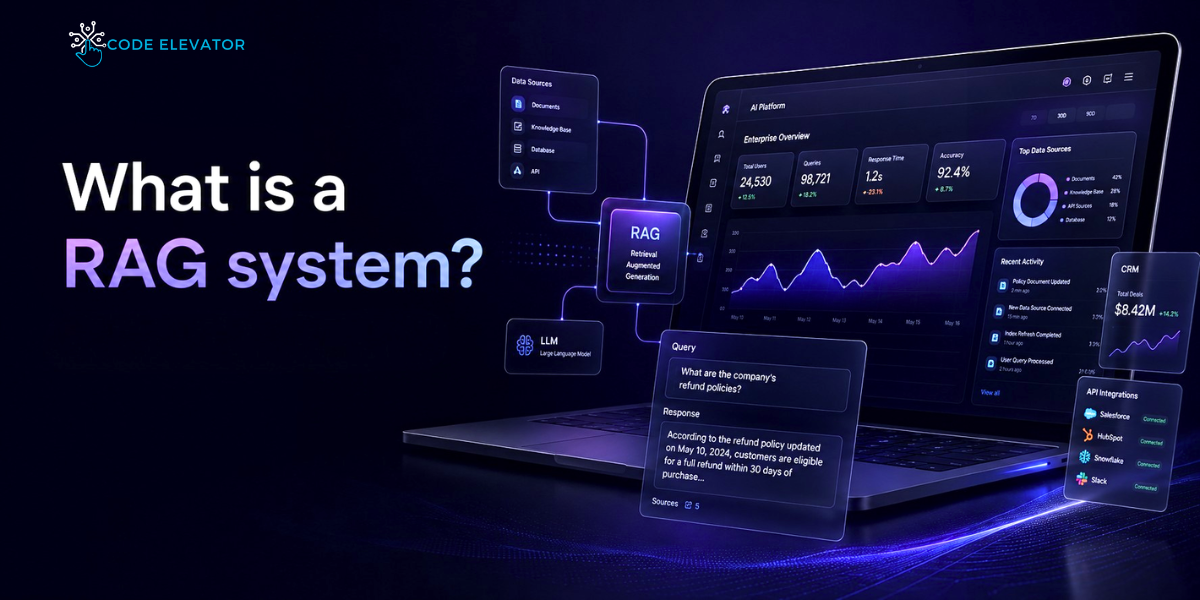
The short answer to what is a RAG system is this: it is an LLM connected to your company’s knowledge, so it can fetch relevant information before answering. Think of it as an open-book AI system, not a model trying to memorize your whole business.
That sounds simple, but the difference matters. A generic chatbot answers mostly from its pretraining and your prompt. A RAG system answers from your approved documents, knowledge base articles, tickets, policies, or product docs. That makes it more practical when your facts change every week.
What is a RAG system and how does retrieval-augmented generation work?
Retrieval-augmented generation means the model looks up information at query time. A user asks a question. The system searches your company content for the most relevant snippets. It passes those snippets into the model. Then the model writes an answer grounded in that material.
That is why RAG is often the first move for internal knowledge search and support automation. You do not need to retrain a model every time pricing changes or a policy gets updated. You update the source content instead.
A useful founder mental model comes from the MIT Tech Review overview of retrieval-augmented generation and the NIST AI Risk Management Framework: RAG is less about teaching the model new facts forever and more about controlling what information it can reference right now.
What is a RAG system made of: data sources, retriever, vector search, and LLM
If you are asking what is a RAG system, you do not need the math. You need the moving parts:
- Data sources: help center articles, SOPs, product docs, PDFs, ticket history, policy pages
- Embeddings: a way to turn text into searchable meaning
- Vector search or retrieval layer: the system that finds relevant chunks
- LLM: the model that turns retrieved content into a readable answer
- Application logic: citations, permissions, fallback rules, logging
Here is the unvarnished truth: founders often obsess over the vector database and ignore the documents. That is backward. If the source material is stale or contradictory, the RAG system will return stale or contradictory answers faster.
For teams planning broader AI rollouts, this is why RAG implementation services usually start with content review, not model tinkering.
What Is a RAG System Best For in a Growing Company?
The best answer to what is a RAG system is not technical. It is operational. RAG is strongest when the problem is knowledge access. If your team already has useful information but people cannot find it, trust it, or keep it current, RAG can help.
It is usually not the right first answer when the real problem is workflow design, bad documentation habits, or missing ownership.
Retrieval augmented generation for business: internal knowledge base and support use cases
For growing companies, retrieval-augmented generation usually fits a few high-value use cases:
- Internal knowledge assistants for HR, finance, ops, and product teams
- Support deflection using approved help center content
- Agent copilots that surface the right answer during live support chats
- Policy and SOP Q&A where citations matter
- Customer-facing product assistants grounded in docs and user guides
A mid-market healthcare practice, for example, cut patient intake processing from 8 minutes to 90 seconds with a HIPAA-aligned RAG workflow trained on EHR documentation and approved internal intake rules. The gain did not come from “smarter AI.” It came from making the right documents retrievable at the right moment.
If your use case sounds like “help people find the right answer from approved content,” RAG is usually worth testing. If it sounds like “make the model behave differently every time,” that is a different architecture conversation.
Is RAG just a fancy chatbot or a real production RAG system?
A lot of teams ask what is a RAG system and then build a chat box on top of a few PDFs. That is not a production RAG system. That is a demo.
A real production RAG system needs:
- Grounded responses tied to approved sources
- Citations so users can verify answers
- Access controls so users only see what they should
- Content ownership so someone maintains source quality
- Fallback logic when confidence is low
- Logging and evals so failures are visible
A Series B fintech might launch an internal compliance assistant that answers AML procedure questions. If the answer cannot show which policy version it came from, the system is not production-ready. In regulated settings, traceability matters more than fluency.
If you are planning customer-facing AI, see how this differs from general AI agent development services and broader AI automation builds.
What Is a RAG System vs Fine-Tuning?
This is where what is a RAG system becomes a budget and architecture choice. RAG and fine-tuning solve different problems. RAG is usually about giving the model access to current knowledge. Fine-tuning is usually about teaching the model a stable pattern.
Before you commit, compare the real tradeoffs.
| Approach | Best for | Data needed | Time to first value | Ongoing maintenance | Cost profile | Accuracy risks | Traceability | Typical use cases |
|---|---|---|---|---|---|---|---|---|
| RAG system | Fast-changing business knowledge | 100-5,000 clean docs, FAQs, tickets, SOPs | 4-8 weeks | Medium-high content upkeep | $15k-$80k PoC plus infra | Bad retrieval, stale docs, conflicting sources | High with citations | Help center assistants, internal policy Q&A, agent copilots |
| Fine-tuning | Stable patterns and repeatable outputs | 1,000-50,000 labeled examples | 6-12 weeks | Medium retraining cycles | $30k-$150k+ including data prep | Overfit behavior, stale training examples | Low-medium unless paired with retrieval | Classification, extraction, tone control |
| Generic chatbot / prompt-only | Fast demos and low-risk experiments | Minimal prompt and a few examples | 1-7 days | Low | $1k-$10k | Hallucinations, no grounding, weak control | Low | Internal demos, brainstorming, non-critical Q&A |
For most Series A-C companies, the table points to the same conclusion: start with RAG when your information changes often and your users need verifiable answers. Fine-tuning usually comes later, or alongside RAG, for more predictable formatting or classification work.
RAG vs fine tuning: which is better for changing business knowledge?
If your product, pricing, policies, or support flows change every month, RAG is usually the better first move. You update the knowledge source, re-index it, and the system can answer from the new material. You do not need to keep retraining the model to memorize facts.
Fine-tuning starts to make more sense when the task is stable. Examples:
- classify tickets into queues
- extract fields from standard forms
- follow a specific tone or response format
- handle narrow repeated patterns from labeled examples
That is why “RAG vs fine tuning” is often the wrong debate. The real question is: do you need current knowledge, or stable behavior? Many production systems use both.
For a practical roadmap, many teams start with a virtual AI hiring guide or bring in short-term expertise before staffing up fully.
RAG system cost, timeline, and team needs for a 4–8 week PoC
A narrow RAG PoC is realistic in 4 to 8 weeks if you keep the scope tight. That means one use case, a few approved data sources, and clear success metrics.
A realistic PoC usually needs:
- One product or ops owner
- One engineer or AI builder
- One content owner from support, docs, or operations
- Security or compliance review if sensitive data is involved
Typical PoC costs often land between $15,000 and $80,000, depending on integration complexity. Model API costs are usually not the biggest line item. People time is.
That surprises founders. The expensive work is:
- cleaning docs
- structuring metadata
- setting permissions
- testing retrieval quality
- reviewing bad answers
- maintaining ingestion pipelines
A senior AI engineer in the US can cost $180,000 to $250,000+ in base comp alone, which is why many teams test a narrow PoC before hiring full-time. If you need to hire AI developers, match speed and prior RAG experience matter more than flashy resumes.
What Makes a RAG System Fail in Production?
If you are still asking what is a RAG system, here is the answer most vendor explainers skip: a RAG project usually fails because the company’s knowledge is a mess, not because retrieval is impossible.
This is why production RAG is more of a content operations project than a pure AI project.
Why do RAG systems hallucinate even with company documents?
RAG reduces hallucinations. It does not remove them.
A RAG system still goes wrong when:
- the retriever pulls the wrong chunks
- the source docs are outdated
- two documents conflict
- the user asks an ambiguous question
- the prompt logic is weak
- the system answers when it should abstain
A fintech compliance team might ask an internal assistant about escalation thresholds. If the system indexes last quarter’s policy and this quarter’s update without version rules, the answer may sound confident and still be wrong.
The fix is not “get a better model” by default. Start with:
- Approved sources only
- Version control and document owners
- Confidence thresholds
- Citations in every answer
- Fallback to human review for risky queries
- Eval sets based on real user questions
The Stanford HAI AI Index and public engineering posts from LLM providers keep showing the same pattern: output quality depends heavily on data and evaluation, not just model size.
How to keep a RAG knowledge base up to date without creating a maintenance mess
This is where many RAG projects quietly break. The first demo works. Then nobody owns the content.
To keep a production RAG system healthy:
- Name a source of truth
- Pick approved systems for V1
- Exclude Slack and random shared drives
- Clean the content
- remove duplicates
- archive deprecated docs
- fix broken structure
- Chunk intelligently
- split documents into answer-sized sections
- keep headings and metadata attached
- Tag content
- product line
- policy version
- audience
- region
- permission level
- Set a review cadence
- weekly for support and pricing
- monthly for internal SOPs
- quarterly for stable policy libraries
- Re-index on schedule
- every content update should trigger a refresh path
- Track failure patterns
- unanswered questions
- wrong citations
- low-confidence cases
- content gaps
A Series A SaaS company may have 300 help center articles, but only 80 are current enough for a support assistant. Starting with those 80 usually beats indexing every document in the company.
FAQ:
What Is a RAG System and What Should Founders Know Before Building One?
Is a RAG system safer than fine-tuning for sensitive company data?
Not automatically. Safety depends on access controls, storage rules, logging, and governance, not just architecture. A badly configured RAG system can expose confidential data just as easily as another AI setup. For sensitive use cases, pair RAG with role-based retrieval, audit logs, and an AI governance for enterprises plan.
How long does it take to build a production-ready RAG system?
A narrow PoC can often ship in 4 to 8 weeks. A production-ready RAG system usually takes longer because it needs integrations, evals, permissions, monitoring, and review workflows. If compliance is involved, expect extra time for legal and security signoff.
Do I need a vector database to build a RAG system?
Not always. If your use case is small and your documents are well-structured, simpler retrieval methods can work at first. A vector database becomes more useful as content volume, semantic search needs, and filtering complexity grow. Tool choice matters less than content quality.
Can a RAG system replace my support team?
Usually not. A RAG system can reduce repetitive ticket load, improve first-response speed, and help agents find the right answer faster. It works best as ticket deflection plus agent assistance, not as a total human replacement for complex or sensitive cases.
What is the minimum amount of data needed for a RAG system to work?
There is no magic number. A smaller, cleaner knowledge base often beats a huge messy one. If you have 50 to 100 high-quality articles that answer recurring questions, that is enough for a useful pilot.
Can we use a RAG system with regulated or confidential data?
Yes, but only with controls. Healthcare, finance, HR, and legal workflows need approved data sources, role-based access, retention rules, audit logs, and clear human review triggers. The NIST AI RMF is a practical framework for scoping those controls early.
Conclusion
If you came here asking what is a RAG system, the useful answer is not just “retrieval-augmented generation.” It is a business decision about whether AI that looks things up at answer time can solve a real problem faster, cheaper, and with less risk than fine-tuning or a generic chatbot.
For most Series A-C companies, RAG is the practical first move when knowledge changes often and traceability matters. But the real project is rarely vector search. It is content cleanup, ownership, permissions, review workflows, and ongoing evaluation. That is why some RAG demos look great in week two and fall apart by month three.
The smartest path is to scope one narrow use case, choose approved sources, assign content owners, and define success before code starts. If you are evaluating what is a RAG system for support, internal knowledge, or a customer-facing assistant, a focused PoC discussion will tell you quickly whether your data is ready and what production will actually require.
Get a free consultation today!
Book a free demo with Code Elevator IT Solutions.
Call Now: +91 91045 04898