
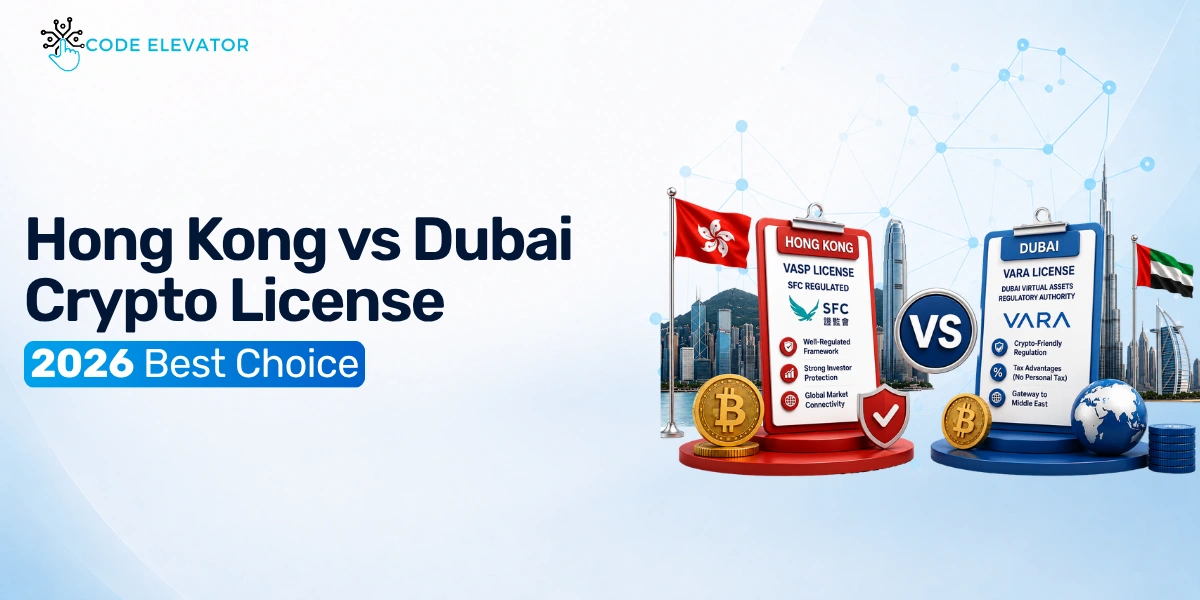
Hong Kong vs Dubai crypto license is not really a legal comparison. It is an operating model choice. Founders usually think they are picking a regulator. In practice, they are picking their future banking setup, token listing policy, staffing plan, and how much runway gets trapped in compliance before the first serious order hits the book.
That matters because plenty of exchange teams reach application stage with a polished deck, a decent crypto exchange development guide, and maybe even a market maker term sheet. Then they hit the real bottlenecks: weak fiat rails, unclear custody governance, token committees that exist only on paper, and regulator questions they cannot answer in one email. A license does not fix bad operating design.
For a 2026 launch, the short version is simple. Hong Kong fits teams that need stronger banking credibility and can live with a tighter token menu. Dubai fits teams that want broader market flexibility and global reach, but can tolerate more friction on fiat banking and staged approvals. The rest of the decision sits in the details.
Hong Kong vs Dubai crypto license: which operating model fits your 2026 launch
The real Hong Kong vs Dubai crypto license decision is this: do you want banking-first discipline or commercial flexibility first?
Hong Kong pushes founders toward a narrower, more controlled spot exchange model. That usually means fewer listed assets, heavier internal governance, and better odds of getting traditional banking conversations taken seriously. Dubai gives you a wider commercial field. You can often build around broader token access and cross-border growth. But wider freedom brings more internal risk work and more uncertainty around stable fiat rails.
Who should choose Hong Kong vs Dubai crypto license first
Choose Hong Kong first if your 2026 thesis looks like this:
- Spot-heavy venue
- Institutional or higher-quality retail flow
- Real fiat deposit and withdrawal needs
- Conservative token roadmap
- Board and investors who care about banking credibility
Choose Dubai first if your thesis looks like this:
- Global retail or cross-border user acquisition
- Broader token coverage
- Faster commercial iteration
- Founder relocation to UAE is realistic
- You can launch crypto-to-crypto first if fiat slips
A practical example: an Asia-focused exchange planning BTC, ETH, and a few majors with HKD and USD rails will usually fit Hong Kong better. A global growth team planning 60+ spot pairs and aggressive affiliate expansion will usually fit Dubai better.
When Hong Kong vs Dubai crypto license is the wrong first move for your exchange
Sometimes the honest answer is neither.
If you have less than 18 months of runway, no compliance lead, no custody design, and no banking strategy, a top-tier jurisdiction can burn your budget before launch. Founders often underestimate how much operating cash disappears into legal, policy drafting, local staffing, audits, and regulator response cycles.
If your projected first-year volume is modest, and your product-market fit is still weak, a full Hong Kong vs Dubai crypto license debate may be premature. First prove you can acquire users, keep spreads tight, and operate surveillance cleanly. Then step into a jurisdiction that matches the business you actually built. That brings us to the licensing path itself.
Hong Kong vs Dubai crypto license requirements that change launch timelines
The headline issue is not just whether you can get approved. It is whether you can get approved and be launch-ready at the same time.
A lot of teams treat licensing and exchange buildout as parallel tracks. They are not. Regulators will look through your application into your wallet governance, withdrawal controls, incident response, and AML stack. If those are immature, the timeline stretches.
Hong Kong VATP license requirements, MSO overlap, and what spot exchanges can actually offer
Hong Kong’s VATP regime is supervised by the SFC. For spot exchanges, it is one of the more structured frameworks in the market. You need serious policies around client asset segregation, custody, token due diligence, market surveillance, cybersecurity, and fit-and-proper standards for controllers and responsible officers. The SFC’s own materials make clear that custody and client protection are central, not optional .
The catch is scope. A Hong Kong VATP is not a blank check for every product line. For a 2026 spot launch, founders should assume spot first, narrow listing logic, and conservative rollout. If your fiat model touches money service activity, you may also need to think through MSO overlap and regulator coordination. That alone can add structuring time.
A mid-stage exchange targeting Hong Kong spent four months longer than planned because its fiat flow diagram was too vague. Client deposits hit one entity, settlements hit another, and treasury controls were not mapped cleanly. Once it redrew the workflow and added daily reconciliation controls, banking talks resumed. That is typical.
Dubai VARA crypto exchange license path: MVP, Full Market Product, and activity-specific approvals
Dubai’s VARA path is attractive because it gives founders more room commercially. But the path is also staged. Teams often simplify it as “get VARA, then launch.” That is too optimistic.
In practice, you should model MVP-stage progress, then Full Market Product readiness, plus activity-specific permissions. If you want exchange services, custody, broker-dealer functions, or more than a narrow activity set, expect the application burden to expand. Review your legal structure and operating model against the VARA rulebooks early, not after incorporation.
This is where many Hong Kong vs Dubai crypto license comparisons go wrong. Dubai can look faster on paper. But staged approvals, extra questions around activity scope, and banking delays can erase that perceived advantage. A realistic plan for either jurisdiction is stronger than an optimistic plan for the “easier” one.
Hong Kong vs Dubai crypto license comparison: banking, token scope, and compliance burden
After approval, the real work starts. This is where Hong Kong vs Dubai crypto license becomes a practical P&L question, not a legal one.
Your banking setup affects conversion, retention, and treasury risk. Your token policy affects volume and monitoring burden. Your custody setup affects regulator confidence and operational fragility. The trade-offs are sharp.
Hong Kong vs Dubai crypto license compared: capital, banking access, token rules, custody, and reporting
| Factor | Hong Kong VATP | Dubai VARA |
|---|---|---|
| Banking credibility | Higher | Mixed |
| Token breadth | Narrower | Broader |
| Fiat ramp comfort | Better odds | Less predictable |
| License path | Single regime, strict | Staged, activity-based |
| Ongoing reporting | Heavy | Heavy |
| Custody scrutiny | Very high | Very high |
| Retail posture | Controlled | More flexible |
| Capital lock-up pressure | Meaningful | Meaningful |
The biggest operational difference is still banking. Hong Kong’s conservatism can be frustrating on listings, but it tends to help when talking to banks and payment processors. That matters if your launch model depends on fiat settlement. The hidden cost of weak banking is not just inconvenience. It is lower conversion, slower withdrawals, and support tickets that destroy trust.
Dubai gives more room on token menu and market reach. That can lift fee revenue faster. But the exchange has to absorb more compliance and listing governance internally. If your token review committee is weak, Dubai becomes dangerous fast.
How stablecoins, client asset segregation, and AML/CFT obligations differ between SFC and VARA
Both jurisdictions care about segregation of client assets, wallet governance, and AML/CFT controls. Neither will accept vague claims like “funds are safe in cold storage.” You need policy, thresholds, logs, segregation logic, and exception handling.
On stablecoins, founders should expect more caution in Hong Kong and more case-by-case operational review in Dubai. Do not build your business plan on unstable assumptions about stablecoin treatment. Model fallback rails.
For AML/CFT, both regimes align with FATF expectations. That means:
- Sanctions screening on onboarding and ongoing basis
- Blockchain analytics alerts triaged by risk score
- Travel Rule handling where applicable
- Escalation workflows for suspicious activity
- Clear withdrawal holds for mismatch scenarios
If your stack still routes Travel Rule messages manually or relies on spreadsheet-based alert handling, you are not regulator-ready. This is where KYC AML for exchanges stops being a policy file and becomes live operations. With those obligations in mind, cost planning becomes much more concrete.
Hong Kong vs Dubai crypto license costs, staffing, and go-live readiness
Founders usually budget the visible costs and ignore the expensive ones. Legal fees get attention. The real damage comes from weak staffing, redesign work after regulator questions, and delayed fiat readiness.
A Hong Kong vs Dubai crypto license decision should be modeled as a 24-month operating plan, not just an application budget.
Crypto exchange licensing costs in Hong Kong vs Dubai and the hidden cost of weak fiat rails
Direct costs vary, but both jurisdictions can become expensive once you add:
- Legal and regulatory advisers
- Compliance manual drafting
- Local entity and office commitments
- Audit and security testing
- Key staff hires
- Banking application rounds
- Rework after regulator feedback
The hidden cost is weak fiat rails. A Dubai launch that goes live without dependable banking often ends up patching together EMIs, offshore accounts, manual treasury sweeps, and delayed settlements. That hurts user trust immediately.
One exchange planned to launch with AED and USD support in under 10 months. It got partway through approvals but still lacked stable banking. The team launched crypto-to-crypto first, then spent another five months rebuilding payment operations. User conversion from registration to funded account stayed under 18% until fiat normalized.
By contrast, Hong Kong can feel slower upfront, but if the banking stack lands earlier, the commercial result can be better.
What your matching engine, wallet stack, and governance model must show regulators in 2026
Your exchange technology matters as much as your lawyers. Regulators will expect evidence that the platform can operate safely under stress. That includes:
- Matching engine controls
- Deterministic order handling
- Trade surveillance inputs
- Rate-limit protections
- Failover testing
See also matching engine architecture.
- Wallet and custody design
- Hot wallet exposure caps
- MPC or multi-sig approval flows
- Cold storage segregation
- Withdrawal queue batching
- Hot wallet drain prevention
A good reference point is a mature MPC custody guide.
- Governance evidence
- Listing committee minutes
- Access control matrix
- Incident response runbooks
- Daily client asset reconciliations
- Proof of reserves tied to liability records, not marketing theater
A sensible 2026 setup might keep 5% to 10% of client assets in hot wallets, batch standard withdrawals every 60 seconds, and require 3-of-5 approvals for treasury moves above a fixed threshold. That is the kind of design regulators and auditors can actually test.
FAQ about Hong Kong vs Dubai crypto license
Is it faster to get a Hong Kong VATP or Dubai VARA crypto exchange license in 2026?
Usually, neither is truly fast. Dubai may appear quicker because of staged progression, but that same staging can extend the path to full operating scope. For a serious spot exchange, assume 12 to 18 months is realistic in either case once legal setup, regulator feedback, banking, and tech readiness are included.
Can I use a third-party custodian for a Hong Kong VATP or Dubai VARA exchange?
Often yes, but do not assume outsourcing removes accountability. Regulators will still want to see governance over key management, reconciliations, incident escalation, and client asset segregation. Whether you build in-house or rely on a provider, your control model must be defensible.
What are the personal residency requirements for directors under VARA?
You should treat local substance as a real requirement, not a box-ticking exercise. Exact structuring depends on your activity set and entity setup, so get current local advice. In practice, founders pursuing VARA should plan for meaningful UAE presence in management and compliance functions.
What are the restrictions on marketing to retail users in Dubai and Hong Kong?
Both require care, but Hong Kong tends to be more conservative in retail posture and token scope. Dubai can offer more flexibility, but retail marketing still needs to align with approved activities, disclosures, and target-market rules. Do not let your growth team run ahead of your license perimeter.
Which jurisdiction is better for venture funding and banking credibility for a new exchange?
If investor diligence focuses on banking certainty and conservative regulation, Hong Kong often reads better. If the story is global market reach and broader token-driven growth, Dubai can be more attractive. The stronger answer is the one that matches your actual launch thesis and operating model, not founder preference.
Conclusion
The right Hong Kong vs Dubai crypto license choice depends on what your exchange is actually trying to become in its first two years. If you need credible fiat rails, tighter controls, and a cleaner story for banks and institutional counterparties, Hong Kong is often the better first move. If your edge is token breadth, cross-border expansion, and faster commercial iteration, Dubai may fit better, provided you budget for banking friction and staged approvals.
Do not choose based on headline friendliness. Choose based on fiat reality, listing strategy, custody design, and runway tolerance. Before filing anything, map your licensing stack, banking path, custody controls, and go-live workflow end to end. If those pieces are not coherent, the jurisdiction will not save you. If they are coherent, the Hong Kong vs Dubai crypto license decision becomes much clearer and far less expensive to get wrong.
Get a free consultation today!
Book a free demo with Code Elevator IT Solutions.
Call Now: +91 91045 04898