

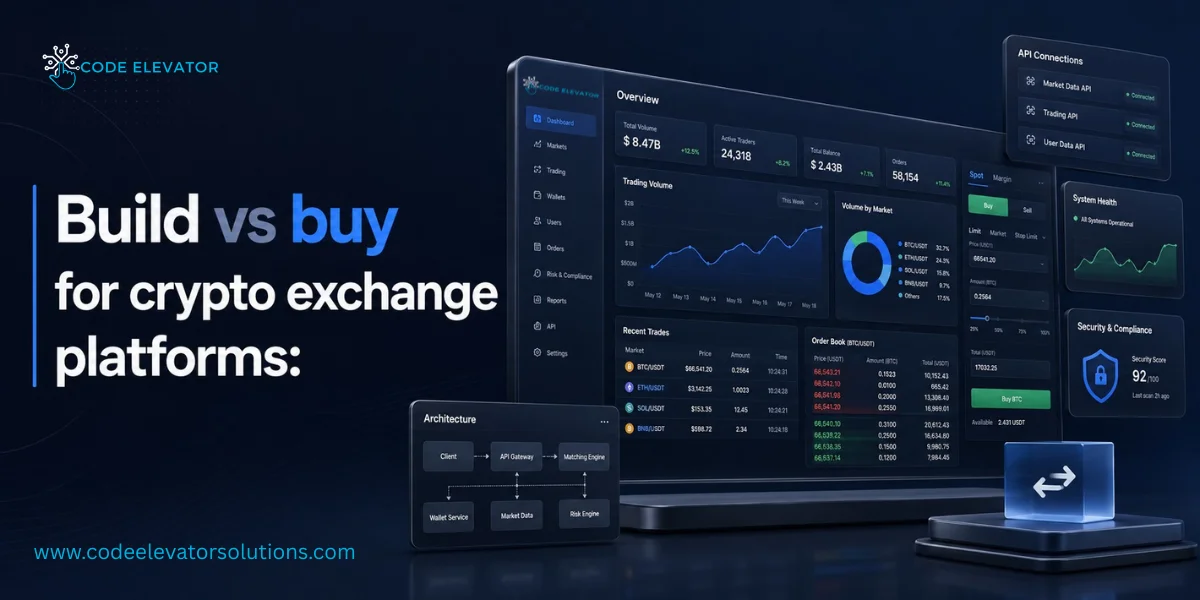
Build vs buy crypto exchange is rarely a launch decision. It is a five-year operating model decision that shapes your burn, licensing path, product roadmap, and the kind of team you need to hire. Seed and Series A teams often treat it like software procurement. Then year two arrives, regulators ask harder questions, and the platform that looked cheap becomes expensive.
The mistake is usually the same. Founders price the first invoice, not the full system. A crypto exchange platform is not just a matching engine and branded front end. It is custody, wallet operations, KYC/AML orchestration, incident response, chain monitoring, liquidity, reporting, and 24/7 operational discipline. Those layers decide whether you launch quickly and whether you can still evolve later.
A white label crypto exchange can compress launch into a few months. A custom build can buy you more control. Neither path is inherently right. The right question is what you should own, what you should rent, and what technical debt you are accepting. That is where the real cost sits, so let’s break the decision down properly.
Why build vs buy crypto exchange is a 5-year cost decision, not a launch decision
A build vs buy crypto exchange decision affects four things at once:
- Speed to market
- Roadmap control
- Regulatory fit
- Long-term total cost
If your goal is to test demand in one geography with spot trading and limited customization, buying more of the stack can make sense. If your roadmap includes derivatives, institutional workflows, or expansion into stricter jurisdictions, the short-term savings of buying can disappear fast.
One mid-stage operator learned this the hard way. It launched on a licensed platform in under 90 days, but by year two it needed custom reporting for a stricter regulator, a different withdrawal approval flow, and support for a second KYC provider. Delivery kept slipping because those features sat behind the vendor’s broader roadmap. The exchange spent nine months working around constraints before budgeting for migration.
What “build” and “buy” actually include in a crypto exchange platform
When founders discuss build vs buy crypto exchange options, they often compare only the visible layer. The real scope is wider.
Build usually means you are responsible for:
- Matching engine and order management
- Account ledger and balance reconciliation
- Wallet infrastructure and custody orchestration
- Admin panel and ops tooling
- KYC/AML and sanctions screening integrations
- REST, WebSocket, and sometimes FIX APIs
- Node operations and chain support
- Post-launch support and incident response
Buy usually means you license a prebuilt crypto exchange platform that includes most of those modules, but with vendor-defined architecture, roadmap, and integration limits. You still own legal setup, compliance operations, banking relationships, market maker management, and day-to-day exchange operations.
For a cleaner overview of core modules, see this crypto exchange development guide and this primer on white label crypto exchange explained.
Build vs buy crypto exchange timelines and budget ranges at seed and Series A
For seed teams, a white label crypto exchange often launches in 2 to 4 months if scope stays tight. Expect $50,000 to $250,000 upfront depending on branding, integrations, and custody model, then monthly platform fees, support fees, and sometimes revenue share.
A production-grade custom build usually takes 12 to 18 months and $500,000 to $1 million+ before it is truly ready for live users. That range often excludes serious legal work, fiat integrations, and post-launch operational staffing.
Early staffing also differs.
Buy path staffing
- 1 product owner
- 1 technical lead
- 1 compliance lead or MLRO
- 2 to 4 operations staff
- Vendor dependency for engineering depth
Build path staffing
- 4 to 8 backend and frontend engineers
- 1 DevOps or SRE
- 1 security engineer or external security partner
- 1 product lead
- 1 compliance lead
- 24/7 support plan before launch
Those numbers explain why build vs buy crypto exchange is a board-level decision, not just a tech one. Once timelines and staffing are clear, the hidden cost factors become easier to spot.
Build vs buy crypto exchange: the 7 cost factors founders usually miss
The first quote almost never captures the full cost. Founders usually miss seven categories:
- Custody and wallet design
- Compliance workflows
- Node and chain operations
- Security testing and monitoring
- 24/7 support coverage
- Customization and roadmap delay
- Migration cost later
These costs hit differently depending on whether you build, buy, or take a hybrid route. But they hit either way.
Crypto exchange development cost beyond the matching engine
The matching engine gets attention because it is easy to demo. It is not where most early budget overruns come from. A better way to think about crypto exchange development cost is by operational systems.
The expensive layers are often:
- Wallet and custody design: hot/warm/cold segregation, MPC signing thresholds, withdrawal batching, address management
- Multi-chain support: Bitcoin, EVM chains, Solana, Tron, TON all create different monitoring and fee-management problems
- KYC/AML orchestration: OCR, liveness, sanctions screening, transaction monitoring, manual review queues
- Node operations: sync drift detection, failover, mempool handling, archive node requirements
- Security work: code review, penetration testing, bug bounty setup, secrets management
- Incident response: 24/7 on-call, withdrawal freezes, chain congestion playbooks, compromised key response
One mid-tier exchange processing about 800 new accounts per month replaced manual KYC review with OCR plus risk scoring and cut approval time from 52 hours to under 9 minutes. First-pass approvals reached 94%. The gain came from workflow design, not from the trading engine.
If you want technical detail on order routing and engine trade-offs, this matching engine architecture guide is useful.
White label crypto exchange pros and cons over 3-5 years
The best argument for buying is speed. The biggest risk is lock-in.
White label crypto exchange pros
- Faster launch
- Lower upfront spend
- Prebuilt UI, admin tools, and APIs
- Existing KYC/AML integrations
- Vendor-managed updates
White label crypto exchange cons
- Recurring license fees
- Possible revenue share
- Limited control over data models and APIs
- Shared codebase risk
- Slow custom feature delivery
- Costly migration later
The Year-3 cost is the one founders miss. If you outgrow the platform, migration is not a theme change. It can involve:
- Exporting balances, orders, and user data
- Rebuilding API compatibility
- Moving wallets or changing signing flows
- Re-running KYC on some users
- Running old and new platforms in parallel
- Updating regulator filings and outsourcing records
That is why white label crypto exchange pros and cons should be priced over 36 to 60 months, not over the first launch quarter.
How build vs buy crypto exchange affects regulation, custody, and architecture
Regulators do not care whether your vendor promised compliance. They care whether you can explain your controls, your outsourcing oversight, and your operational resilience.
That matters for MiCA in Europe, Travel Rule obligations under FATF guidance, and stricter licensing reviews in places like Singapore, Hong Kong, and the UAE. Useful references include the FATF guidance on virtual assets, the ESMA MiCA page, and the Chainalysis blog for practical AML and sanctions trends.
Wallet types compared: hot, warm, cold, MPC, and multi-sig
Wallet architecture is one of the clearest examples of why build vs buy crypto exchange is really about control and operational burden.
| Wallet Type | Control | Security | Ops Burden | Withdrawal Speed | Regulated Exchange Fit |
|---|---|---|---|---|---|
| Hot wallet | High | Lower | Medium | Seconds | Partial |
| Warm wallet | High | Medium | Medium | 1–10 min | Yes |
| Cold storage | High | Highest | High | Hours | Yes |
| MPC wallet | High | High | Medium | 30 sec–5 min | Yes |
| Multi-sig wallet | High | High | Medium–High | 2–30 min | Yes |
A practical model for many regulated venues is:
- 5% to 10% of assets in hot wallets
- Warm wallets for daily rebalancing
- Cold storage for treasury reserves
- MPC or multi-sig approval for larger transfers
- Threshold escalation for transfers above a set value, such as $250,000
One platform operating under a stricter Asia-Pacific regime reduced withdrawal backlog from 4 hours to 11 minutes after combining MPC threshold signing with batched withdrawals every 60 seconds. The lesson was straightforward: custody design affects user experience, staffing, and risk.
For a more focused breakdown, see this MPC custody guide.
Is a white label crypto exchange enough for MiCA, Travel Rule, and stricter licensing?
Sometimes yes. Often not without material adaptation.
A white label crypto exchange can support a regulated launch if it gives you enough control over:
- KYC and enhanced due diligence rules
- Sanctions screening cadence
- Travel Rule message routing
- Withdrawal holds and manual reviews
- Audit logs and role-based access
- Reporting exports
- Disaster recovery and incident records
The weak point is usually not basic compliance. It is outsourcing governance and change control. Regulators may ask:
- Can you document critical outsourced functions?
- Can you show incident escalation steps?
- Can you evidence wallet controls in your environment?
- Can you swap vendors if needed?
- Can you support new jurisdiction-specific reporting?
If the answer depends on vendor goodwill, you have a problem. A helpful starting point is this MiCA compliance checklist and this guide on KYC AML for exchanges.
How to choose build, buy, or hybrid based on your exchange business model
The right choice depends less on ideology and more on where your edge actually sits.
Ask four questions:
- Are you differentiating on product or distribution?
- How much runway do you have?
- Which jurisdictions do you want within 3 years?
- Will you need custom workflows that a vendor will not prioritize?
If your core advantage is community, local market access, or a partner channel, buying more of the stack is reasonable. If your edge depends on proprietary execution logic, institutional reporting, or custom margin rules, ownership becomes more valuable.
When buying is the right move to start a cryptocurrency exchange
Buying is often the right move when:
- You need to start a cryptocurrency exchange quickly
- You are validating one market and one core product
- Spot trading is enough for phase one
- Your team is small and runway is tight
- You can tolerate vendor limits for 12 to 24 months
This path works well for founders prioritizing launch, distribution, and revenue proof. Just set terms early:
- Own your data contractually
- Get export rights in usable formats
- Clarify deployment model
- Define support SLAs
- Price migration before signing
When to build or use a hybrid crypto exchange tech stack
Build or hybrid becomes stronger when you need:
- Derivatives or structured products
- Custom risk logic
- Prime or institutional workflows
- Multi-jurisdiction expansion
- Deep reporting control
- Flexible custody architecture
- Multiple liquidity venues and routing logic
A hybrid model often makes the most sense. Build the parts that define your edge. Buy specialized layers such as custody, KYC orchestration, or fiat connectivity. That gives you more architectural freedom without forcing you to rebuild everything from scratch.
One new exchange launched with 12,000 registered users but only $40,000 in daily volume. The issue was not frontend quality. The order book was too thin. After signing three market makers and adding two liquidity bridges, volume climbed to $4.8 million within 60 days. The build vs buy decision did not solve liquidity by itself, but owning routing logic made iteration much faster. For more on that side, see liquidity aggregation strategies and fiat on-ramp integration.
FAQ
How much does a white label crypto exchange cost?
A white label crypto exchange often costs $50,000 to $250,000 upfront for a basic launch, plus monthly fees, support retainers, and sometimes revenue share. The real number depends on custody model, custom integrations, and whether the vendor includes liquidity or compliance tooling.
How much does it cost to build a cryptocurrency exchange from scratch?
A serious production build usually lands around $500,000 to $1 million+ before launch. That estimate often excludes legal setup, licensing, banking, market maker retainers, and full 24/7 support staffing.
Can I build a crypto exchange using open-source software?
Yes, but open source lowers license cost more than it lowers delivery risk. You still need security review, wallet operations, node maintenance, patch management, compliance integrations, and engineers who can support the stack long term.
What are the typical project timelines for building an exchange from scratch?
For most teams, 12 to 18 months is realistic for a production-ready launch with wallets, admin tools, APIs, testing, and operational controls. Faster builds are possible, but usually by cutting scope or pushing risk into post-launch operations.
How to choose a white label crypto exchange provider?
Ask about data ownership, API access, deployment model, incident history, separate instances versus shared codebase, regulator-facing documentation, and migration rights. If they cannot explain termination and export clearly, treat that as a red flag.
When does it make sense to move off a white label crypto exchange?
Usually when your roadmap starts colliding with vendor limits. Common triggers include derivatives, institutional clients, stricter licensing, custom custody flows, or recurring delays on core feature requests. If those pressures are visible now, price migration into the original build vs buy crypto exchange decision.
Choosing build vs buy crypto exchange well means thinking past launch day. The fastest route is not always the cheapest, and the most flexible route is not always the smartest for a seed-stage team. What matters is whether your platform can survive regulator pressure, product expansion, and year-three operational reality without a painful transplant.
The practical takeaway is simple. Own the parts that create your edge. Rent the parts that are specialized but non-differentiating. Price everything over three to five years. That includes license fees, payroll, security work, compliance changes, and the cost of migrating if the initial decision stops fitting your business.
If you are pre-MVP, the best next step is a structured architecture review before signing a vendor contract or hiring a full build team. A few hours spent pressure-testing your build vs buy crypto exchange assumptions now can save a year of rework later.
Get a free consultation today!
Book a free demo with Code Elevator IT Solutions.
Call Now: +91 91045 04898